

YOUTH ENGAGEMENT STRUCTURE & GOVERNANCE
INTRODUCTION
Youth engagement strategies, including Youth Advisory Boards (YABs), youth feedback collection, and youth leadership, provide meaningful opportunities for young people to participate in the shaping of programs and policies in their local communities. This guide highlights promising practices for developing effective structure and governance for engaging youth. The structure outlined here reflects approaches commonly used successfully; however, communities vary in their resources and capacities, and as a result each youth engagement structure may look different.
Effective youth engagement requires a proactive approach to structure that is intentional, supportive, and ensures participation is reciprocally beneficial to youth and the community. The structural outline in this document is one that is designed to create stable support and a solid foundation from the bottom up.
This resource was created by Lauren Leonardis of Rind and Reason Consulting LLC.
If you haven’t already, pop over to this page about choosing AN appropriate compensation model to find more resources & learn about YAB history: Choosing an Appropriate Compensation Model
& If you’re ready to start building your youth engagement model, check out the YAB Milestone Guide.
A SOLID FOUNDATION
Many organizational structures and government bodies are top-down, the boss is in charge and directs the work to those working below them. There isn’t always a lot of room for worker feedback or workers making significant changes to how their work is supposed to be completed. So how do you create a youth engagement model that works differently within an existing system?
It’s easy to think that the solution to an overly-structured system is to create one without structure (hello, anarchy). While this kind of intentional lack of structure can sometimes work out, it can also very easily fall apart - and when something is created without any structure it tends to create its own structure, for better or worse.
For this reason, it’s best to be proactive about creating a youth engagement model that is intentionally created with stable support and a solid foundation from the bottom up, with a strong goal of increasing youth leadership and engagement within the community. Young people should be able to benefit just as much as they are giving to their community.
Youth Engagement
Youth engagement looks different from community to community, especially across big cities and rural communities, and is largely dependent on the funding available, the geography, and the capacity of staff.
When the funding and staff capacity allow it, many communities choose to have two tiers of youth engagement: 1) a low responsibility, low commitment option that allows for broader information collection from more youth; and 2) specific for Youth Leadership roles which require a higher expectation, commitment, and responsibility from both the youth and the community.
Remember to put quality above quantity.A smaller group of young people with more hours to work alongside community partners rather than a large group that only has minimal time to dedicate to the work is more likely to accomplish your shared goals.
Low Barrier Engagement
There are many benefits to being able to gain feedback from a larger group of young people in a low barrier setting. It can allow the community to tap into a range of recent experiences within their region, and better identify gaps and needs in programs.
General YAB Membership
Communities define eligibility for YAB membership in many different ways, but the common eligibility criteria for general YAB membership is that a young person is under 25 years old and has either recently been or is currently homeless within their community. This type of YAB membership is designed to be low-barrier, allowing for an open-door for any eligible young person to join at any time. Members typically meet once or twice a month for one to two hours, and have the opportunity to provide feedback on the topics that are brought to them - similar to a focus group structure with the added benefit of consistency.
General YAB members are not expected to take on additional responsibilities or complete work outside of YAB meetings. Responsibilities are reserved for youth in leadership roles.
While this model has been the most popular in the past, many communities have learned from it and decided to move away from it due to the significant barriers with engaging a rotating group of young people who have minimal hours to dedicate to projects. Instead, communities are favoring hiring a Youth Leadership Team.
There are many challenges in making sure a general YAB is well supported and appropriately compensated, so a promising practice is to be realistic with the number of youth who can participate, pre-plan a maximum number of YAB members that can attend meetings based on the budget and the staff support’s ability to manage, and be even more realistic about whether this model is right for the community and the youth involved.
Youth Feedback Collection
There are many other useful tools to meaningfully collect information and hear youth voice across the community; these include surveys, focus groups, integration of youth voice into the Continuous Quality Improvement plan, and more. These feedback collection methods are the lowest-barrier and least resource-intensive options for the community.
These methods should not replace advisory boards or leadership models, but they can allow communities to integrate youth feedback into their processes when the capacity does not exist to support more youth involvement. These methods are also a helpful addition when combined with youth leadership, allowing for youth leaders to professionally develop data collection skills that will benefit them in future employment opportunities.
Youth Leadership
Youth Leadership roles are for young people who have been homeless in the recent past who are more intentionally involved in the work, typically composed of a cohort of 2-5 young people with either part time or full time hours, for a set time period of 1-2 years.
Youth Leadership roles are trained and supported to take on many responsibilities such as reviewing and writing policies, gathering and analyzing data, attending committee meetings as representatives of the local youth population, and more.
Due to the nature of these responsibilities, leadership is a higher-barrier form of youth engagement than other options.
Communities use a range of methods to select leaders, from peer nomination to formal hiring processes. A promising practice is to implement a formal hiring process that is deeply informed by what YAB members, other youth in the community, the host organization, and partners would like to see in Youth Leadership. Together they can create a rubric to use in the selection process to decide what skills are necessary, what can be learned along the way, and what qualities they are looking for. This can be used by the hiring team to ensure everyone’s thoughts are included when new Youth Leaders are being selected.
Youth leadership teams require a very different kind of supervision and support; in order to work well it must look different than other staff roles in the host organization. Accountability needs to go both ways, flexibility is a must, and support must be plentiful. When set up with a lot of intentionality these types of leadership roles are the most beneficial type of youth engagement.
A strong structure for youth leadership results in notable advantages to the youth and the community. Youth leaders gain huge amounts of knowledge, leadership experience, and deeper engagement in system-level work that will benefit them for the rest of their lives. They can receive training, contribute meaningfully to decision-making, and leave with professional skills they can take to future employment. Youth Leaders can fully commit to the work without having to prioritize other life demands because the work is committing to them, too. And finally - they are more prepared to take on similar types of work elsewhere in the community, creating an overall positive impact.
The community benefits include having strong insights into gaps and strategies from a group of reliable and consistent Youth Leaders. Having a dedicated Youth Leadership team also means that partners are not constantly re-explaining things to new members, making processes smoother along the way. This creates an overall more sustainable and impactful model for youth engagement.
ORGANIZATIONAL STAFF SUPPORTERS
The organizational supports necessary for successful youth engagement include the staff responsible for supporting youth engagement and holding space for youth within the larger system. These staff are often called the “adult supporters” but can also include older or more experienced young people who’ve experienced homelessness in a Coordinator role, providing more opportunity for growth and leadership.
The role of the staff supporter is to help youth stick to their goals and commitments: supporting them in task management and keeping tabs on various projects and spaces youth can be involved in; helping to guide them in professional spaces; and capable of both giving and receiving feedback with respect and understanding.
To provide the best assistance for youth, their primary support should be someone already highly skilled in program management and supportive supervision.
Youth engagement models are hosted in many different types of organizations. Depending on where the YAB is hosted there needs to be a dedicated staff person within the host organization, as well as within the CoC, if these are separate. This ensures that youth remain connected to both organizational and system-level work.
Think about an upside-down hierarchy triangle when creating staff support roles! The tip of the triangle’s job is to hold up and support their staff. Being supportive, flexible, and youth-friendly makes all the difference.
SYSTEM SUPPORTS
System Supports are the external structures that impact how youth engagement functions uniquely within a community. These include the host organization, CoC, community partners, and funders.
System partners hold structural power over youth engagement implementation; acknowledging this reality is the first step towards establishing shared decision-making that aligns with community goals.
Host Organization Types
The host organization plays a significant role in how youth engagement functions within a community, including access to decision-making, system integration, and available resources.
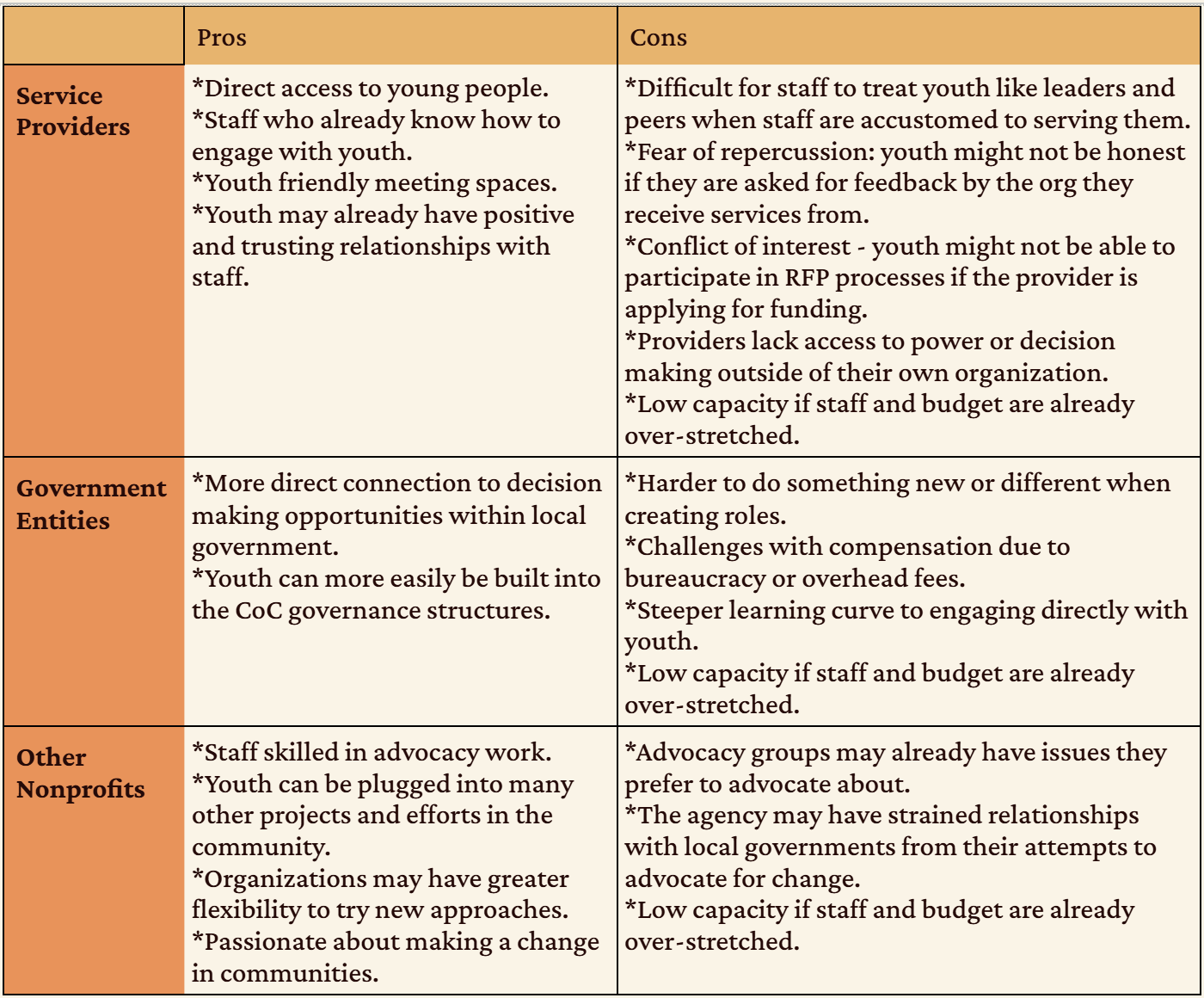
Hosts generally fall into three categories: service providers, government entities, or other types of nonprofits such as advocacy groups or coalitions. There are different pros and cons for each host organization type.
There is no single preferred host model; the key requirement is that the host can reliably provide the structure and support necessary for youth engagement success. This includes managing appropriate compensation, supporting hiring processes, overseeing strategic planning, administering budgets, providing supervision, maintaining infrastructure, and more.
Sometimes a youth engagement model can outgrow its host. If a host is no longer able to provide the necessary supports, communities may need to reassess or transition host structures to ensure youth engagement efforts continue to receive the necessary support and infrastructure. It’s encouraged to think creatively about what other organizations can fill the gap without having too many cooks in the kitchen, or to relocate to a new host to ensure youth engagement can continue to get what it needs.
SAMPLE DOCUMENT: YAB Roles, Rights, & Responsibilities
The below sample is based on a real community’s roles, rights, and responsibilities documents, written in 2025. This sample has been edited for clarity outside the context of their unique community and anonymized for the purpose of sharing it here.
_____________
The Youth Action Board (YAB) Roles, Rights, and Responsibilities include the specific roles that support the YAB, a body dedicated to representing the voices of Youth and Young Adults who have been homeless or housing unstable in the county. These specific roles and responsibilities support uplifting the voices of youth including YAB leadership, YAB Program Manager, and systemic supporters. The roles and responsibilities provide a foundation for collaborative leadership and advocacy. They empower young people to amplify their voices and strengthen initiatives focused on addressing and preventing homelessness.
YAB Membership
Open YAB Meetings
The Open YAB Meeting is a monthly meeting for Youth and Young Adults ages 18 - 26 who have been homeless or housing unstable. These meetings provide a structured yet flexible space for youth engagement, and serve as a forum where participants can share their experiences, provide critical input, and influence decisions that shape policies, programs, and initiatives.
Responsibilities
Agree to uphold the YAB’s Mission and Vision
Actively participate and listen during meetings.
Commit to the group agreements.
Follow the accountability process.
Rights
Provide input on projects and materials.
Have a vote on YAB decisions.
Be paid for participation.
Receive report backs on how feedback was incorporated.
YAB Leadership Team
The YAB Leadership Team consists of up to 4 young people, preferably previous general YAB members, and are hired in part-time paid positions. Team members hold their positions for a one-year term, with the opportunity for a second year. The Leadership Team works alongside the YAB Program Manager, and community partners to work towards the community and YAB goals around ending youth homelessness. Through their role, YAB Leadership Team members are provided support and supervision to gain the tools and skills to effectively carry out the responsibilities outlined below.
Responsibilities
Commit to and support the YAB’s mission and vision.
Contribute to the preparation and facilitation of Open YAB Meetings
Participate in online and in-person meetings.
Use technology to effectively communicate and coordinate work, including with phone, text, email, Microsoft Suite, and Google Drive.
Assist with outreach to help build and strengthen community among young people and partner organizations.
Gather feedback from young people and community partners through the Open YAB Meetings, surveys, focus groups, and other methods to inform projects and strategies.
Act as a YAB representative in meetings.
Provide input and partner on the YAB and YHDP strategic planning and CoC funding competition.
Be a collaborative team member.
Adhere to the agreed-upon accountability process.
Share resources, events, and learnings from community events with the participants at Open YAB Meetings.
Participate in learning opportunities, including projects, training, and conference participation and presentation.
Provide insight and expertise to CoC committees, workgroups, and initiatives regarding issues related to youth homelessness and connect YAB members to appropriate groups and initiatives.
Create newsletters and flyers for Open YAB Meeting participants.
Support with other YAB tasks as needed.
Rights
A vote on internal YAB decisions.
A fair and transparent accountability process.
Be supported in gaining tools and skills needed to effectively carry out YAB Leadership responsibilities.
Be compensated appropriately and fairly.
YAB Support Staff
YAB Program Manager
The YAB Program Manager is a hired full-time staff position, currently held by a previous YAB Leadership Team member. This position oversees and leads the daily operations of the YAB, and provides supervision and support to the YAB Leadership Team.
Responsibilities
In the event that YAB members aren’t able to uphold responsibilities for any reasons, ensure YAB work is able to move forward by either identifying another member to step in or temporarily completing tasks.
Oversee strategic planning efforts for YAB and YHDP in collaboration with CoC Program Manager, YAB, and YHDP partners.
Uphold YAB mission and vision.
Invest in Authentic Youth Leadership through targeted resources, opportunities, and collaborative decision-making that reflect YAB Members’ perspectives and experiences.
Act as the YAB’s advocate by pushing for actions that align with YAB goals and mission.
Ensure communication is free of jargon and works with different learning styles.
Demand and provide transparency for the YAB in all spaces in which they work.
Represent the YAB in community meetings with partner agencies, community leaders, and elected officials.
Facilitate YAB members' active participation in meetings, conferences, and convenings.
Identify training and professional development opportunities for YAB Leadership Team, including projects, trainings and other professional development opportunities that match interests.
Offboard members through individualized transition plans and celebratory send-offs.
Coordinate YAB projects, including managing tasks and timelines, and matching YAB members to projects that align with their interest, capacity, and current skills.
Support YAB leaders in learning to plan and facilitate YAB and YHDP meetings, including agenda development, activities, room set up/breakdown, and materials.
Work with CoC Program Manager in the fiscal management of the YAB including integrating YAB member feedback and identifying funding sources.
Support, maintain, and build intentional partner relationships with organizations that work with diverse populations, including other populations advisory boards.
Adhere to and uphold the agreed-upon accountability process.
Participate in relevant conferences and convenings.
Lead recruiting and hiring process for YAB Leadership Team.
Work with contract partners, funders, and County administration to create and sustain infrastructure for YAB member positions and activities.
CoC Program Manager
The CoC Program Manager is a leadership role within the CoC that oversees and implements all CoC Lead roles and responsibilities in the community. As part of this role, the CoC Program Manager supports the YAB Program Manager and YAB/YHDP efforts, including providing opportunities for integrating youth and young adult efforts into overall efforts to prevent and end homelessness.
Responsibilities (in connection to the YAB)
Support strategic planning efforts for YAB and YHDP in collaboration with YAB Program Manager, YAB, and YHDP partners.
Oversee a continuous quality improvement process that engages YAB Leadership Team members for YHDP-funded projects, including feedback loops, review of data outcomes, recommendations for improvement, and follow-up with grantees.
Provide supervision and support to the YAB Program Manager.
Connect YAB to related work in CoC and community-wide efforts to prevent and end homelessness.
In the event that the YAB Program Manager is unable to uphold responsibilities for any reason, ensure YHDP and YAB work is able to move forward by either identifying another staff to step in, temporarily completing tasks, reprioritizing efforts to meet current capacity, and/or hiring new staff.
Participate in occasional Open YAB or YAB Leadership Team meetings as needed.
Ensure CoC funding competition is informed by YAB and a YHDP-specific approach is taken into account.
YAB Systemic Supporters
Host Organization
The host of the YAB is the organization that provides fiscal, administrative, and staff support required to implement all YAB activities. The current host of the YAB is the county.
As the host organization, the responsibilities to the YAB include:
Staffing YAB support roles that implement responsibilities as stated in this document
Support the strategic planning and development of the YAB
Support the YAB’s financial stability by:
Identifying and securing funding
Negotiating and managing funding contracts
Manage the YAB budget.
Administer stipends for participants of Open YAB Meetings
Provide meeting space for YAB activities
Maintain open and transparent communication with the YAB, including any limitations or constraints.
Collecting data related to the YAB Program.
Rights
Final decision-making on fiscal items for YAB, including budget and contracts.
Final Decisions on staffing of the YAB, including hiring or firing.
Funders
Funders are any entity that supports the YAB financially, either by donation or through contract.
Responsibilities
To uphold the contracts that they have consensually agreed to.
Rights
To decide whether or not they would like to financially support the work of the YAB.
